Mind the Other Gap: the gap between “probably fine” and “definitely fine”

Rail access has got so much better. So why do I get nervous before a half-hour trip into London? Trains, ramps, and a very small invention.

I was about three when I fell in love with trains.
I'd just got polio, and I was lying in an iron lung. Those machines had an angled mirror fixed above your head, so you could see a little of the world behind you. In my mirror was a viaduct. And across that viaduct went the steam trains.
I couldn't hear them. I just watched the carriages roll past, and the smoke drift away. In silence, and back to front.
I've loved trains ever since.
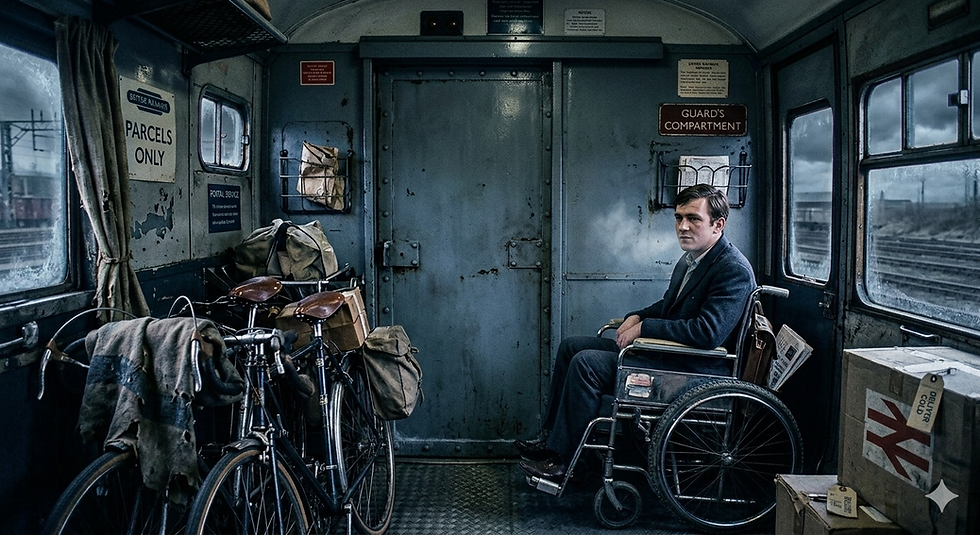
The grown-up version of that love has mostly been happy. For years I've travelled by train as a wheelchair user, big city centre to big city centre. Apart from the odd hiccup, it's been reliable and pretty stress-free. Credit where it's due. Things have improved a lot.
More recently, I've tried something new. I drive to Hatfield and catch the train into King's Cross. It takes about half an hour. The same trip by car can take up to two. At my age, an hour and a half is not to be sniffed at.
So far, so sensible. But here's the thing.
Before I go anywhere, I have to book. The ticket, obviously. Then the assistance, which for me means a ramp on and a ramp off. And to book assistance, I have to say what time I'm coming back.
Going is easy. I know when my meeting starts, and I want to be there on time. Coming back is guesswork. Meetings overrun. Conversations get interesting. Someone says, "While you're here…" And somewhere, a ramp is waiting for a train I'm no longer going to catch.
There is an on-demand service. You can just turn up. But you're gently encouraged not to. Plan ahead is the message. Book it in.
Then there are the apps. One for tickets. One for assistance. One to check the train is actually running. I've got them all on my phone, and I'm pretty handy with tech. But I haven't used them enough to feel at home. Each one has its own way of doing things. Each one is another thing to get right.
So I do all of that. I plan, I book, I commit to a time I can't really commit to. Then I arrive at the station to find the train has been cancelled.
What happens next is surprising. Staff put me on the next train. Someone radios ahead. When I pull into King's Cross, someone's waiting with the ramp. So far, it's worked.
Which leaves me scratching my head. The system asks me to plan every detail. Then, when the plan falls apart, it improvises beautifully. The bit I'm told not to rely on is the bit that saves the day.
Now, I'm not a nervous person. Ask anyone. But I've noticed I get jittery before these trips into London. For a while I couldn't work out why. It's a half-hour journey. I've done far harder things.
I think I know now. It isn't the train. It's one small question that sits in my stomach all the way down the line.
Will anyone be there to get me off?
So far, the answer has been yes. But knowing you'll probably be fine isn't the same as knowing you'll be fine. And the gap between those two is where the nerves live.
That's what reliability means for disabled travellers. It isn't a nice extra. It's what lets us relax. The ramps are there. In my experience, the staff are helpful. What's missing is the confidence that it will all join up.
Here's the odd thing. The technology to fix this largely exists. Station staff now have an app. They can log what assistance I need, and they let the arrival station know when to expect me. When a train's cancelled, they're told straight away. What they don't do is tell me. I find out when I get to the station.
As far as I can tell, there's no app for my phone that says: King's Cross knows you're on the next train. Someone will be there. So I sit there, trusting that a call has been made, with no way to check.
It hardly seems a big invention. One small screen. One small message. Give us that, and a lot of us would sleep better the night before.
When I was three, I watched trains in a mirror and couldn't get anywhere near them.
Now I can get on them.
I'd just like to be sure of getting off.
---
Header image: "The Last Train to Bury" by David Dixon, geograph.org.uk/p/4399750, licensed CC BY-SA 2.0, adapted with a phone overlay.
AI assisted with this article.

Comments