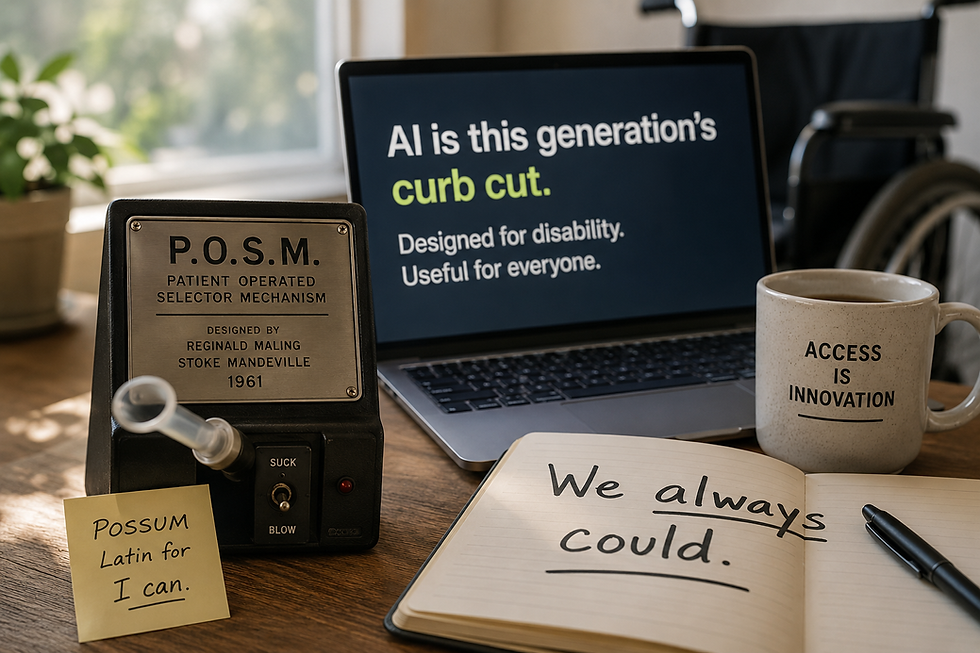
I can. We always could.

A tech writer spent a year using AI for everything and called it a revelation. I'd call it a Tuesday. Here's why disabled people have been doing this for decades — and what that says about the world we live in.
Joanna Stern spent a year using AI to do almost everything.
She's a technology writer. Her new book, I Am Not a Robot, is out this week. She appeared on NPR's Fresh Air to talk about it — the year she used AI to read her medical results, draft her messages, and process her feelings with a chatbot standing in for a therapist. Her conclusion? The emotional dependency disturbed her. She'd handed over so much of herself that she wasn't quite sure where she ended and the machine began.
She called it a revelation.
I'd call it a Tuesday.
In 1961, a young man was lying in the National Spinal Injuries Centre at Stoke Mandeville Hospital. He was paralysed from the neck down. Almost no voice. His only way of alerting a nurse was to blow on a whistle hung near his mouth.
That was it. Blow on the whistle. Wait. Hope someone came.
A man named Reginald Maling was volunteering at Stoke Mandeville. He saw this. He went away, and he designed a mouthpiece. Suck or blow — like a straw. With it, the young man could turn on a light. Change the television channel. Eventually, operate an electric typewriter.
Maling called it the Patient Operated Selector Mechanism. POSM. A near-match for the word possum — which in Latin means I can. I went to a special school, so I had to look that up. In 1966, the Ministry of Health was persuaded to fund the system nationwide for severely disabled people. The company Maling founded still exists today and is based in Aylesbury.
Breath-controlled ambient technology. Available on the NHS. Sixty-five years before anyone called it ambient computing.
Three years later, in 1964, an American physicist named Robert Weitbrecht — deaf from birth — invented the teletypewriter. It converted phone calls into text on a screen. He made the first transatlantic TTY call. The technology he developed became the foundation of text-based telephone communication.
In 1932, the American Foundation for the Blind created recorded books on vinyl. By 1984, IBM had released the first screen reader, built with Jesse Wright, a blind research mathematician. Voice control. Predictive text. Autocaption.
Almost all of it was invented by or for disabled people, then discovered by everyone else and rebranded as innovation.
There's a name for this pattern. The curb cut effect. The dropped kerb at the edge of a pavement was designed for wheelchair users. It turns out it's used constantly by parents with buggies, delivery drivers, cyclists, e-scooters and anyone dragging a suitcase through an airport. Design something for disability, and you often end up designing for everyone.
AI is this generation's curb cut. The executive assistant, the tool that summarises your emails, the system that transcribes your meeting and flags the action points — all of it is the latest version of something disabled people have been doing for decades. Finding a way around. Doing things differently. Making the technology fit the life you actually have, rather than the one the designer imagined.
What makes me smile — not entirely warmly — is what happened with reasonable adjustments.
For years, disabled people asked employers for adjustments. Different formats. Alternative ways of working. Flexibility. Extra time. Many were told no. Too expensive. Too complicated. Too disruptive. I know people who were told that allowing them to work flexibly would set a precedent — and therefore was unreasonable.
Some of those battles have quietly been won without anyone admitting it. Text-to-speech. Voice dictation. Autocaption. They come pre-installed on every device now. Nobody calls them adjustments. They're just features. But others — screen readers among them — are still contested and still treated as special pleading. Still met with concerns about compatibility, cost, or disruption.
Decades on. What was unreasonable in 2015 is sometimes just a subscription now. And sometimes it's still unreasonable.
I'm not saying this to be bitter. I say it because it matters. Every time a non-disabled person discovers that doing things differently actually works, we get a little closer to a world where "reasonable adjustment" stops sounding like a favour and starts sounding like plain common sense.
I should confess something. I've been using AI for several months now. I'm an early adopter — always have been. But what I didn't expect was how much it would help with something I'd quietly worried about for years: getting the words out. The ideas were never the problem. The blank page was. I went to a special school. Writing wasn't really on the curriculum. AI turned out to be my dropped kerb.
Joanna Stern found AI unsettling because it knew her so well. It anticipated what she needed. It adapted to her. It made her life easier in ways she hadn't thought to ask for.
Disabled people have wanted that from the world for a very long time.
The ones who couldn't wait just built it themselves.
Possum. Latin for I can.
We always could.



Comments